
Managing your analytical activity and steering your quality assurance policy
TDMind (Middleware Integrated NexLabs Data) manages your laboratory's result production and supports you in meeting quality management requirements.

Management of any type of instrument
Connect and supervise your analytical production units, from standalone analyzers to robotic lines, whatever their architecture.

Quality control and accreditation
Monitor your internal and external quality controls, verify your methods and automatically produce your SH-FORM 43 reports.

Multi-site and multi-discipline
Manage several sites and laboratories, with validation adapted to each discipline.

Integrated with TDNexLabs
TDMind receives its configuration directly from TDNexLabs, and you have a single point of contact.
Key features
Production management
TDMind connects and supervises your analytical production units, whatever their architecture:
- Connected instruments
- Standalone analyzers
- Robotic lines
- Aliquoters and sorters
- Pre- and post-analytical instruments
- Wide portfolio of connections
- Workflow and automation
- Workflow management
- Automation management
- Multi-site and multi-laboratory organization
- Monitoring and continuous improvement
- Real-time monitoring and alerts
- Indicators (KPIs) to improve the production process
Accordion title
Heading 1
Heading 2
Heading 3
Heading 4
Heading 5
Heading 6
Text paragraph.
Quote
Ordered list
- Item 1
- Item 2
- Item 3
Unordered list
- Item A
- Item B
- Item C
Bold text
Emphasis
Superscript
Subscript
Validation and adapted screens
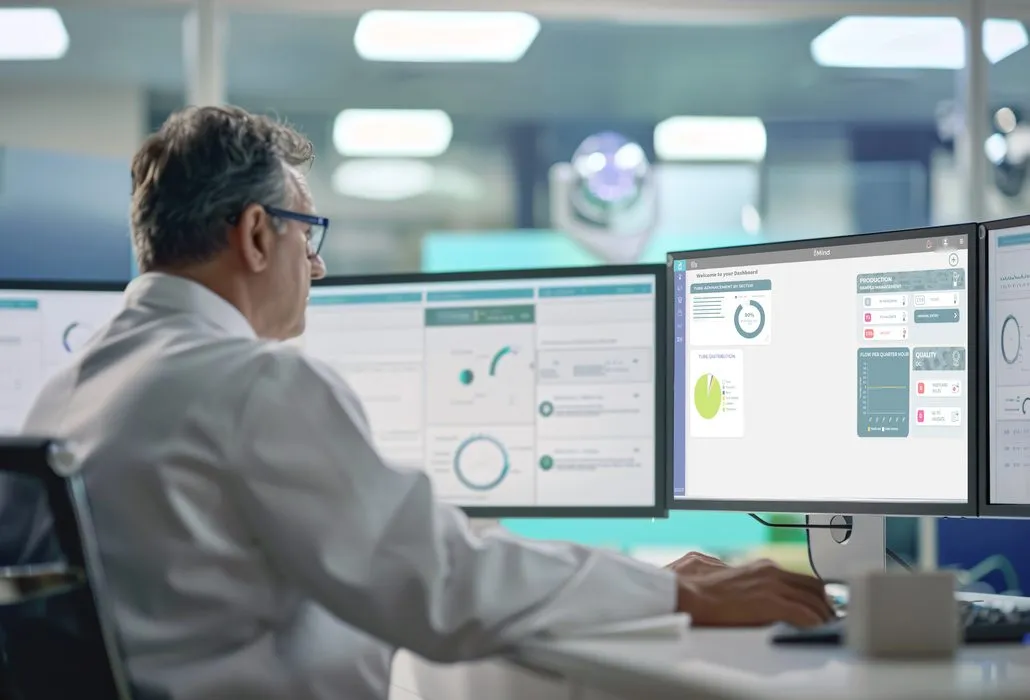
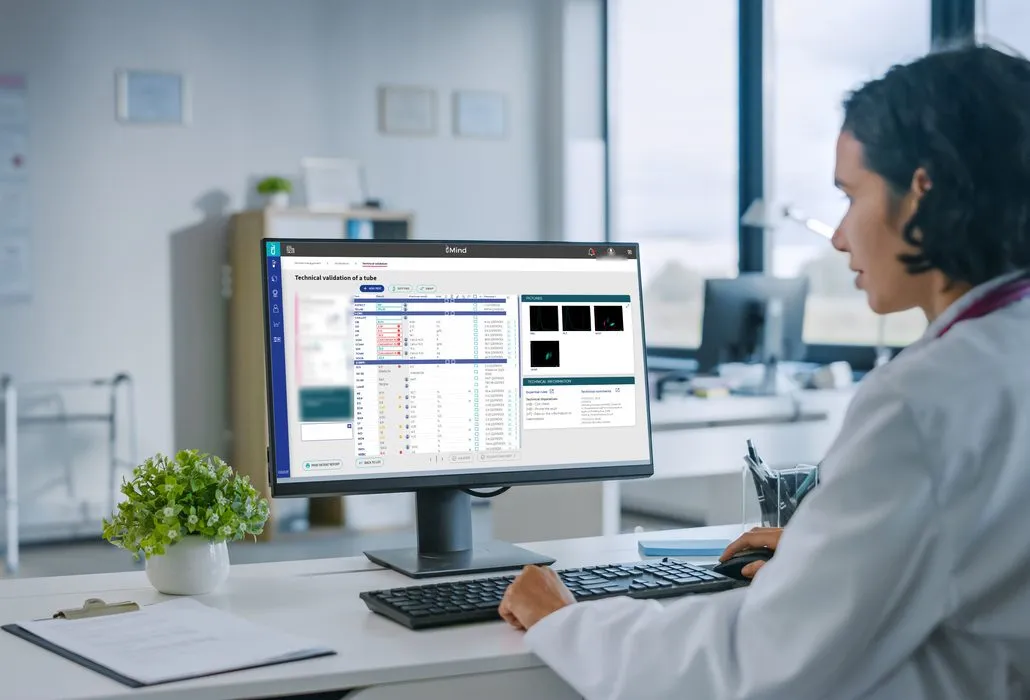
Manage your analytical production through screens adapted to each use:
- Management interfaces
- Worklists
- Counters
- Dashboards
- Alerts
- Technical validation
- Validation adapted to each discipline
- Dedicated screens, for example in hematology and biochemistry
- Expert review and entry
- Expert rules engine
- Microscopy entry
Accordion title
Heading 1
Heading 2
Heading 3
Heading 4
Heading 5
Heading 6
Text paragraph.
Quote
Ordered list
- Item 1
- Item 2
- Item 3
Unordered list
- Item A
- Item B
- Item C
Bold text
Emphasis
Superscript
Subscript
Quality control and accreditation
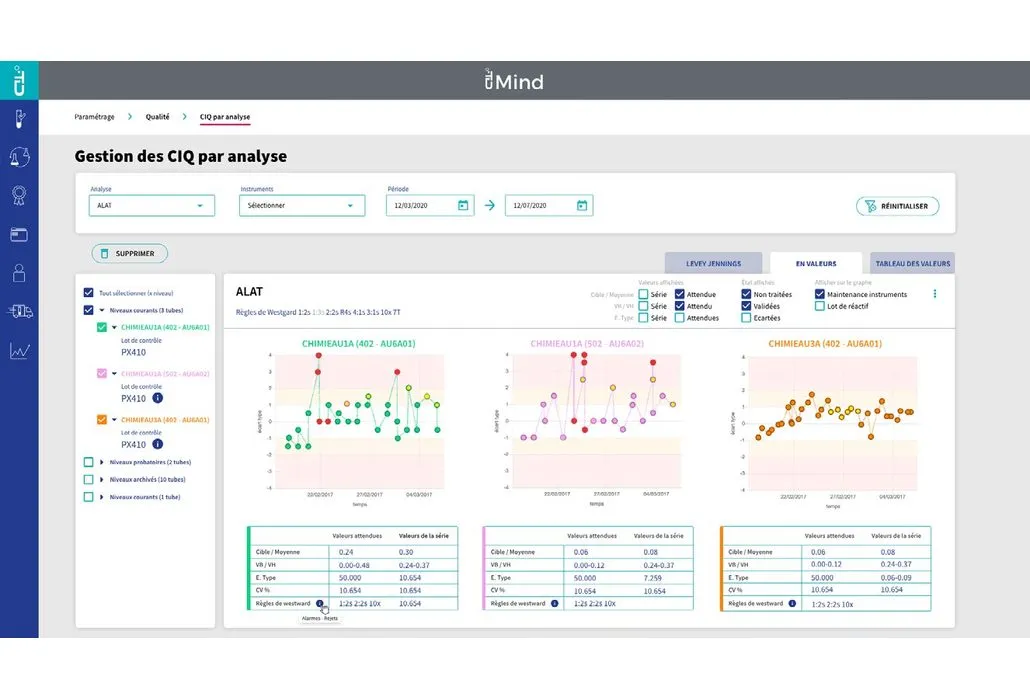
TDMind includes quality control modules and support for the accreditation process:
- Quality control
- Monitoring of internal (IQC) and external (EQA) quality controls
- Multi-level Levey-Jennings charts
- Method verification
- Automatic production of SH-FORM 43 reports
- Support for the accreditation process
- Production traceability
- Maintenance tracking
- Reagent traceability
Accordion title
Heading 1
Heading 2
Heading 3
Heading 4
Heading 5
Heading 6
Text paragraph.
Quote
Ordered list
- Item 1
- Item 2
- Item 3
Unordered list
- Item A
- Item B
- Item C
Bold text
Emphasis
Superscript
Subscript

Integration with TDNexLabs and technical foundation
TDMind is designed to work with TDNexLabs, the TECHNIDATA LIS:
- Synchronized systems
- TDMind receives its configuration directly from TDNexLabs
- Communicating software
- Detailed analytical information available from the TDNexLabs biological validation session
- A single point of contact to make your daily work easier
- Standalone middleware
- Can, for example, serve as a backup for the LIS
- Technical foundation
- Access from a web browser, on any workstation
- No additional hardware
- Infrastructure designed to meet cybersecurity, modularity and stability needs
- Optional database encryption
Accordion title
Heading 1
Heading 2
Heading 3
Heading 4
Heading 5
Heading 6
Text paragraph.
Quote
Ordered list
- Item 1
- Item 2
- Item 3
Unordered list
- Item A
- Item B
- Item C
Bold text
Emphasis
Superscript
Subscript
Accelerate the digital transformation of your laboratory
They trust us
Challenges, solutions, results: discover how our clients use TECHNIDATA solutions every day.
Frequently asked questions
Which devices can TDMind connect?
TDMind connects and supervises analytical production units, whatever their architecture: standalone analyzers, automation lines, aliquoters and sorters, pre- and post-analytical instruments. It relies on a broad portfolio of connections.
How does TDMind integrate with TDNexLabs?
TDMind receives its configuration directly from TDNexLabs, and detailed analytical information is accessible from the TDNexLabs biological validation session.
As a standalone middleware, TDMind can also serve as a backup for the LIS. You have a single point of contact.
How does TDMind support quality control and accreditation?
TDMind monitors internal (IQC) and external (EQA) quality controls, method verification, maintenance follow-up and reagent traceability. Its Levey-Jennings charts cover several control levels, and it automatically generates SH-FORM 43 reports.
It supports the laboratory's accreditation process.
Does TDMind require dedicated hardware?
No. TDMind does not require any additional hardware: it is accessible from a web browser, on all workstations. Its infrastructure is designed to meet cybersecurity needs, and database encryption is possible.
Which disciplines does TDMind cover?
TDMind is designed for the different laboratory disciplines, with technical validation adapted to each of them, for example in hematology and biochemistry. It also manages multi-site and multi-laboratory organizations.